Start with You in Your 20s
Preface
Nobody’s talking to you.
Everything written about you is aimed at your parents. Everyone has a theory about what went wrong: the phones, the feeds, the loneliness, the comparison. Jonathan Haidt turned The Anxious Generation into a movement, and it’s working, but it’s aimed at kids still young enough to protect.
My generation stood by and watched it happen to you.
Your generation carries real weight this book can’t lift. High rent, scarce jobs, a planet on fire. I won’t pretend otherwise.
Attention is the one thing the feeds took that you can take back.
The skills that once got you hired are cheap now. A machine can’t do the one thing nobody taught you: know yourself.
By the end of this book you’ll know what you want, what you bring, and what you can do, in your own words, on these pages.
I couldn’t write this book alone. I grew up in a different world. So I wrote it with my son.
At first I thought my dad was losing it.
He’s always been intense about his ideas. But a couple of years ago he started walking around the house asking people things like: what is your beautiful garden? What is the seed inside you? For a while there, we were worried. Only my grandma would listen to his theories. She lives alone, and his writing room is in her house.
Then I graduated. The more I looked at what he was actually doing, the more I thought, wait. Maybe this guy isn’t losing it. Maybe he’s onto something. The thing he’s describing is exactly what I’m experiencing. But no one else is even talking about it.
So I read the books he kept suggesting to me, mostly to get him off my case. The Defining Decade. Atomic Habits. Deep Work. None of them said what my dad was saying: start with you. I started thinking my friends needed to hear it too.
That’s why I decided to help my dad with this book. Also, he said I could include my photos, and I love photography.
I told him he owes me ten bucks every time he puts the word “beautiful” in this book. That includes each draft he makes me read. Now pay up, Dad.
When you hit an exercise, do it. This book works even better with people your age, asking each other the question nobody asked you. Toby’s taking it on the road to do exactly that. Until he gets to you, start with one friend.
By the end, this won’t be my framework or Toby’s photographs. It won’t even really be our book anymore. It will be your stories, written in the blank spaces.
Nobody asked what you want.
You already know.
Introduction
What do you want to learn?
I’m not asking what you were told to learn. I don’t care what your major requires. What do you want to learn?
I asked a class of students that question. Total silence.
Me: “Wait. When was the last time someone asked you that?”
A hand went up.
Jordyn: “Uh, never.”
The class was Career JumpStart, an elective I teach at Dominican University. Jordyn is studying nursing. She’d told us about her statistics class. She memorizes equations. Nursing requires it.
At the end of class, I tried again.
Me: “Come on. What would you want to learn? Tell us why it matters to you.”
Jordyn: “This might sound kind of random. How food in America affects pregnancy. There’s fertilizers. There’s chemicals in the food now. It’s different in Europe. That’s probably affecting us.”
Something changed. She wasn’t answering my question anymore. She was giving this her full attention, and now the whole class was too. I could have listened for an hour.
She’s taking nutrition next term to find out.
Me: “Wow. You should start a club.”
I was really thinking, I’d vote for her if she ran for president.
All I did was ask. Nobody’s asking.
Every choice you’ve been handed came as a list. Pick a major. Pick a class. Pick a job. Somebody else wrote the options, and your job was to pick one.
I did it too. When I finished at UC Davis, the menu had two items: get a job or go to grad school. I didn’t want a job, so I picked grad school. At Stanford, two kinds of companies recruited from my department: investment banks and consulting firms. Banking seemed terrible, so I picked consulting. My decision analysis professor used to say the lesser of two evils is still an evil.
On my first day, the firm looked at an engineer from Stanford and told me to build spreadsheets. I became the spreadsheet guy. I never really chose it.
I spent years starting with a list.
That’s the first zero. You started with a menu instead of starting with you.
Two more zeros keep you on the menu.
School teaches you how to read, do math, and even drive. Nobody teaches you how to make decisions.
Jordyn’s statistics class is the closest school gets. It teaches how to decide whether to reject a null hypothesis.
That’s the second zero. You never learned how to decide.
School taught you algebra. How many classes did you take on the uniqueness of you?
Let me guess. Zero.
That’s the third zero.
You started with a menu, not you.
You never learned to decide.
You don’t know yourself.
That’s why we wrote this book.
I can confirm all three zeros. Berkeley has a great career center. Some of my friends talked about going. I don’t think any of them actually did. I didn’t either. We just kept getting emails about all the tools the career center had, so we figured that’s what the career center does.
The main tool was Handshake, an app with thousands of jobs you can apply for. It’s a list. You scroll it, you react to it. Every job description asks you to perform a role. After going over enough of them, I realized none fit me. That got me wondering. Wait, who am I? What should I do?
One of my friends had parents who paid thousands of dollars for a career coach. I think it helped. He’s still looking for a job. The rest of us had Handshake.
Career centers are built to help you get a job. But what if you want help thinking about your career? Those are two different things. I didn’t know that until I had a degree with no idea what to do next.
In four years at Berkeley, I took classes on how the brain works, how people form habits, how happiness works. Not one of them asked me what I’m good at, what I wanted to learn, or how to decide.
My dad studied decision analysis in grad school, and he talks about it all the time. I still didn’t know there was a class on how to decide until we started on this book.
I went to the career center at UC Davis once. It had binders of job listings and a workshop on writing a résumé. The best advice I got was to read What Color Is Your Parachute? Thirty-some years later, the binders are an app.
Picking from a list feels like deciding. It’s actually the moment you stop deciding.
This book isn’t another plan to get you off your phone. It’s a plan to get you off the menu.
What if you started with you? What if you wrote your own menu?
Here’s what I’m good at. Here’s what I want to learn. Here’s what I won’t do. Let the world pick from your menu.
I started with the menu, and the world applauded. At 40 my mentor asked me the questions nobody ever asked, and I found my work.
You’ve taken the personality tests. You’ve circled your values. You know your type. They’re all menus.
We don’t do that here. A list asks for your opinion of yourself. This book asks for your evidence. You’re an unreliable judge of your own character. But you’re a reliable witness of your own experience.
So you and I are going to be detectives. We’re going to go back through your life together. The evidence of who you are is already there.
It’s in what makes you lose track of time.
It’s in what your body does when something feels wrong.
It’s in the thing you loved at 15 and dropped when nobody saw the point of it.
One test told me I’m an ENFP. It made good small talk at parties. But it gave me zero clarity about who I am or my career direction.
So I went back through my life.
I didn’t find a type. I found the Sony camera I loved at 15 that I put back in my drawer when nobody saw the point. The hours I spent learning guitar during the Covid lockdown. An elderly woman at an Irish pub in Florence, and the look on her face when she recognized the song I was singing.
None of that was on a test.
I’m not here to reassure you. You were born into a hole you didn’t dig. You’ve been sold solutions by the same machine that dug it. So stop performing. Start paying attention to yourself.
We start with what happened to your generation.
The story begins in a hallway, with a door I should have walked through.

The Graph Moved
You didn’t even know there was a graph.
The 20s were once the happy years.
Now they’re the hardest.
That’s why we’re here.
Walking Back Into the Room
Toby was supposed to be with me in Half Moon Bay. He couldn’t make it, so my friend Aaron came instead.
We got lost. We were at a hotel for an event about happiness, sponsored, strangely, by a vodka company. We’d had one. We were looking for our room or the exit, I can’t recall. We pushed open a door, and there they were.
A handful of people sitting around, relaxed, like it was somebody’s living room. Two of them were Arthur Brooks, the Harvard professor who wrote From Strength to Strength and had given the talk that day, and Vivek Murthy, the Surgeon General of the United States.
The happiness professor and the nation’s doctor. Sitting right there.
They looked up at us in the doorway.
Brooks: “Come join us.”
I froze.
Me: “Oh no, sorry to interrupt.”
We backed out of the room.
Two of the people I admire most in the world invited me to sit down at their table.
Some part of me ran the numbers: those are the real experts. You’re just some guy in a hallway.
You know that voice. If you’re in your 20s, you hear it more than I do. It’s the one that looks at the list and tells you which rooms aren’t for people like you.
Those numbers were wrong. Wrong about me, and wrong about you.
This book is me walking back into that room. Pulling up a chair. Sitting down between the professor and the doctor, because I’m not waiting to be asked this time. The invitation expired years ago. I’m coming in anyway.
Toby’s coming with me. The seat next to mine was his in the first place.
I couldn’t make it. I had to cram for the AP Calc exam that weekend. After hearing my dad’s stories, I’m glad I didn’t go. It sounded like it was a thing for people his age.
Mister Brooks, since we’re all sitting here now, there’s something I have to show you.
It’s a graph. You love graphs. So do I. You showed me one once and it changed my life.
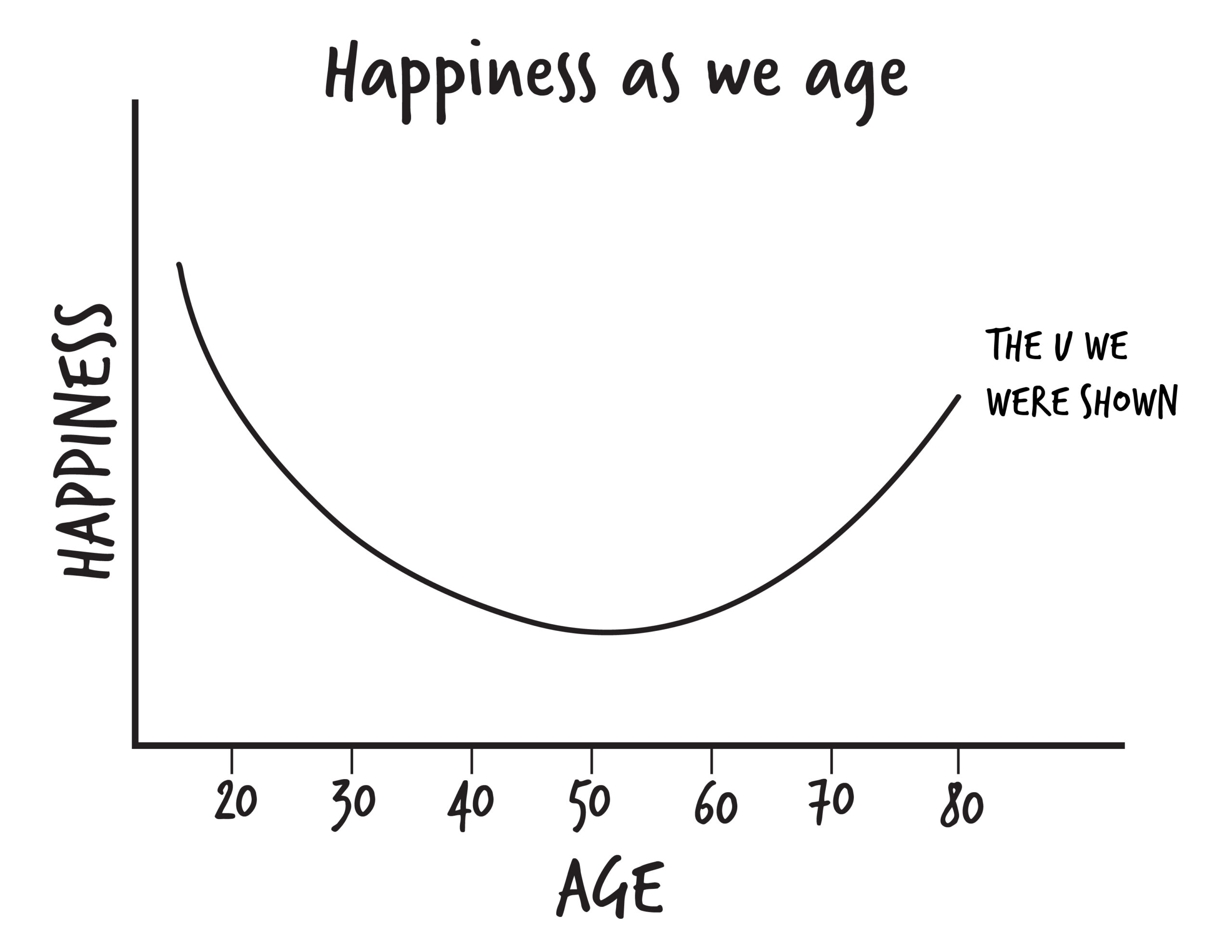
To be fair, you couldn’t have shown me the next one. It didn’t exist yet.
Now I have to show you the one you didn’t show us.
The Graph You Didn’t Show Us
It was our annual summer vacation in Vermont. Toby came back late at night after music and Ben & Jerry’s. I was half asleep.
Toby: “Dad, even Uncle Jim is saying it. ‘You better enjoy it. These are the best years of your life. It’s all downhill from here.’”
Me: “Really? Even Uncle Jim?”
Toby had heard this from other adults, but if even Uncle Jim was saying it, it was time to get to the bottom of this.
Uncle Jim wasn’t the first. In my Science of Happiness class at Berkeley, the professor showed us that same curve from Half Moon Bay: life starts off great, drops through midlife, and climbs back up at the end. A room full of 20-year-olds looked up at a graph telling us we were at the top.
I believed it. Why wouldn’t I? It was on the slide.
We kept running into the work of Meg Jay, the psychologist who wrote The Defining Decade. But she said the opposite of Uncle Jim. Her message was that your 20s are hard. It gets better.
Every time she said it, I argued with her in my head:
“Meg, what are you talking about? You know the U curve. Your 20s are the good part. That’s what the graph in Half Moon Bay said. Uncle Jim is right: It’s all downhill from here. Toby, you better enjoy it.”
When Brooks showed me that graph, I found myself at the bottom and started planning my climb. I thought the people down there were people like me.
Then the new data came out.
In 2025, economists went back to the numbers. The midlife low was gone. In their data, distress was highest among the youngest.
Mister Brooks, this one is going to hurt.
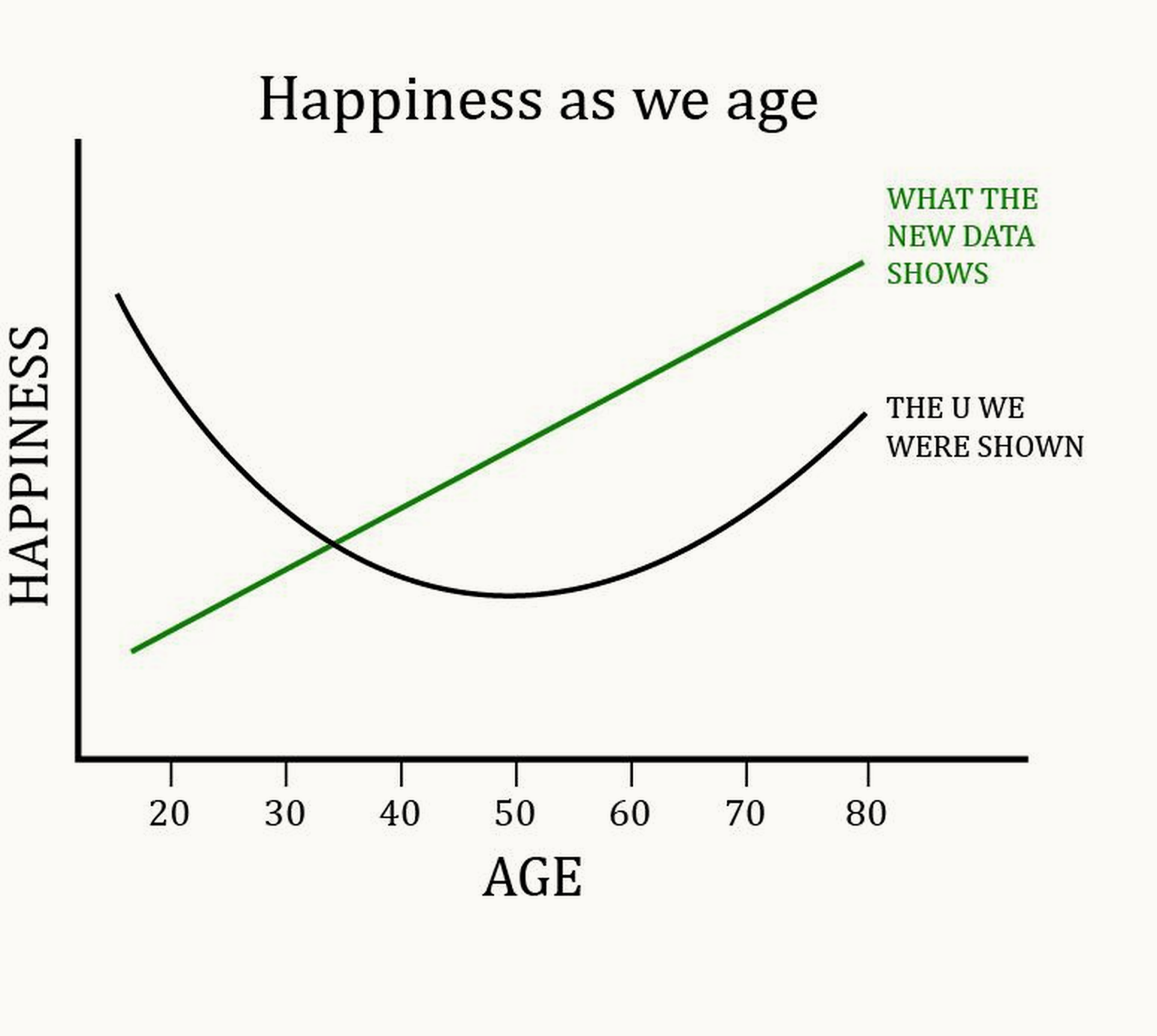
Sorry, Meg. You were right. Your 20s are hard. It can get better.
Look at the very bottom of that curve. It’s not the middle-aged parents. It’s you.
The curve didn’t shift, Mister Brooks. It broke.
The adults who told you these are the best years of your life were reading you a graph from their own lifetime.
A year after that slide in my Science of Happiness class, my dad called:
“Stop whatever you’re doing. You’ve got to see this.”
My dad walked me through the new graph on his phone. If his goal was to get me worried, it worked. Wow, thanks a lot, Dad. A graph that says I’m at the bottom. How is that supposed to help me?
Brooks gave me the answer that same day in Half Moon Bay. He told the story of two geniuses at the end of their curves.
Charles Darwin gave us the theory of evolution, then spent his last decades unable to top it. Near the end, he wrote that his mind had become a kind of machine for grinding general laws out of large collections of facts. He could no longer endure poetry or music. That, he said, was a loss of happiness.
Johann Sebastian Bach was the greatest composer of his day. Then the world moved on. His music went out of fashion, and his own son became more famous than he was. Bach could have spent his last years bitter about it. He didn’t. He taught. He wrote music for his church, his family, his students.
Both men passed their peak. One clung to who he used to be. One gave himself away.
I said to myself, I want to be Bach, not Darwin. I started asking what was still in me to bring into the world.
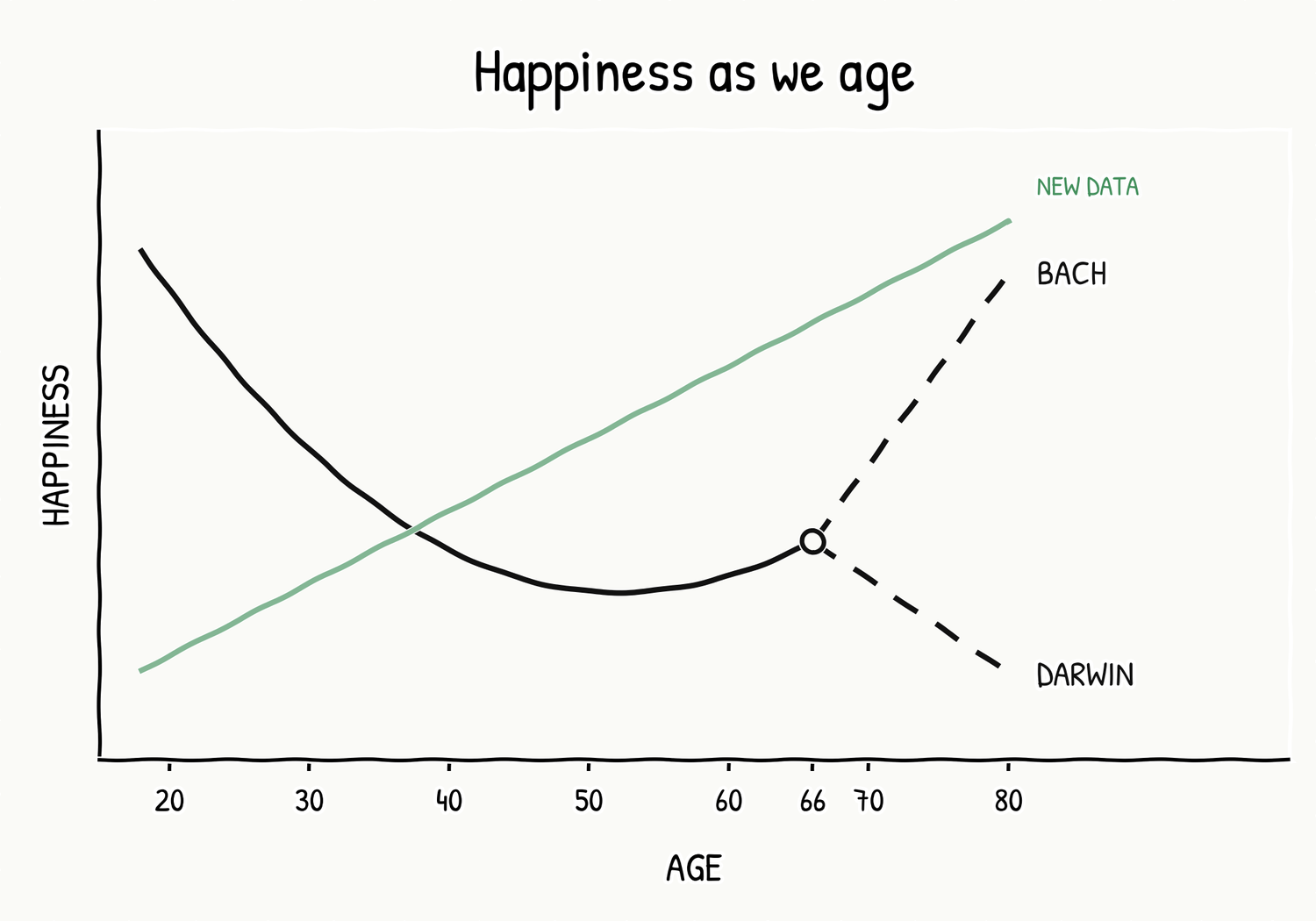
Those curves are averages. An average can’t tell you which way one life goes.
Darwin’s line went down. Bach turned toward whoever was in front of him, a student, a congregation. His line went up.
Alright I get it. Two famous guys had happiness levels that went in two different directions when they got old. But how is that relevant to my generation?
Valid. Both of Brooks’s examples were European men who died before my grandparents were born. So here’s a third.
Maya Angelou stopped speaking for years as a child. She had every reason to trust no one. She turned outward anyway. At 40 she published I Know Why the Caged Bird Sings, and she was famous for the rest of her life. She could have spent those years on a stage. She spent a good part of her 30-plus years at Wake Forest in a classroom.
Dad. When’s the aha moment here?
The point is this is universal. A German composer and a writer from Arkansas had the same instinct. As they got older, they gave what they had to the person in front of them.
Now look at your generation. The feeds built for comparison. The performing. The loneliness that Vivek Murthy, the other man at that table, spent his time as Surgeon General warning the country about.
Darwin got there at the end. The feeds are pushing you there at the start.
But you can be Bach. You can be Angelou. Turning toward what you love instead of what ranks you. Staying close to the people who get you. Giving what you can to the person in front of you.
You didn’t choose the curve you were born into. You do choose which way you turn. You’re choosing it right now.
- 1Put a dot where you are today.
- 2Draw two dotted lines twenty years forward: one climbs, one doesn’t. Label them Bach and Darwin.
- 3On the climbing line, write who’s in the room with you.
- 4Draw the curve of your life from your 20s to today. End it with a dot. Use a different color.
- 5Compare. Where was your lowest point? What made your line climb?
Keep this page.
The rest of this book is about how to build the line that climbs.
Just Love Each Other
The other man at the table in Half Moon Bay had something to say about the bottom of that curve. Vivek Murthy stood up to speak. The nation’s doctor. The office that put the warning on the cigarette pack.
He said the health threat is loneliness. An epidemic. He had the data, the mortality numbers, the comparisons that make headlines. Then he paused. He made eye contact with us, slowed down, and said something that might sound corny coming from the government.
Murthy: “What we really need to do is just love each other.”
He was the nation’s doctor, but nothing about those words was official. He meant what he said.
I sat there stunned. I knew how right he was. I’d seen it up close, in the family I married into.
My father-in-law was Dr. Fariborz Amini. He was a psychiatrist at UCSF, and with two of his colleagues he wrote A General Theory of Love.
His book’s argument is that we’re built, down at the level of biology, to be seen, to be attuned to, to be held in someone’s attention.
Connection isn’t a nice-to-have on top of life. Fari used to tell me, “It’s more like food than entertainment.” The book’s word for the whole system, the one science keeps trying to avoid and keeps circling back to, is the same word the Surgeon General had just said out loud.
Love.
Fari practiced it. When you talked to him, he looked at you as if you were his whole world.
The people at the bottom of that curve are the same people reporting the most loneliness. You have more ways to contact each other than any humans who ever lived. Yet you’re lonelier than the generations who came before you.
You have been experimented on.
The people who built the feeds ran the experiment on you. The results are in. It worked. For them. They got your attention.
Now you run it on yourself. You post the version of you that tests well. Whatever gets attention, you make more of. Soon you’re measuring yourself by it. The feed is the menu for who you are. That’s what they really sold you: a life that succeeds on someone else’s terms and never quite feels like yours.
Stop buying it.
You’re not waiting for approval. You’re waiting to be seen.
In Florence, almost everyone ended up at the same apartments every night. University of California students drinking with other UC students. I didn’t get it. I understand hanging out and drinking with friends, but the whole point was we weren’t just UC students, we were UC students abroad. There was an ancient city right outside the window that they missed. The photos they posted looked like a semester abroad. In reality, all that changed for them were the hashtags and the songs they chose for their insta stories. I went a few times. Everyone was there, nobody was anywhere. I stopped going.
So I walked. Some nights I didn’t know where I was going. I started meeting actual Italians my age. One of them, Giulio, is still my friend. I’ve been back to Florence to see him.
That was an experiment. Toby didn’t call it one, but that’s what it was. The feeds’ experiment took your attention. His gave it.
He walked out of that apartment party looking for connection. I watched him find it on a porch in Vermont.

Uncle Bill was at our family camp in Vermont for what everyone knew was the last time. He had cancer. The morning he left, we all stood in the driveway and said goodbye, and there were tears. Then Toby had his guitar out on the porch, and it was just a few of us: me, Uncle Jim, and a couple of others. He played James Taylor. Cousins started coming in from the lake. By the third song it was the whole camp, twenty of us, every age, on the porch. Then Toby’s aunt asked, “Do you know ‘Lean on Me’?”
He didn’t. He pulled up the chords and started playing it anyway, slowly, finding it as he went. Someone sang the first line. Then everyone. We were all clapping along as we sang.
It wasn’t the guitar, or even that Toby was learning the song in front of us. It was that an hour after we said goodbye to Bill, all of us were right there, together.
That’s how I’ll remember Bill’s last day at camp.
* * *
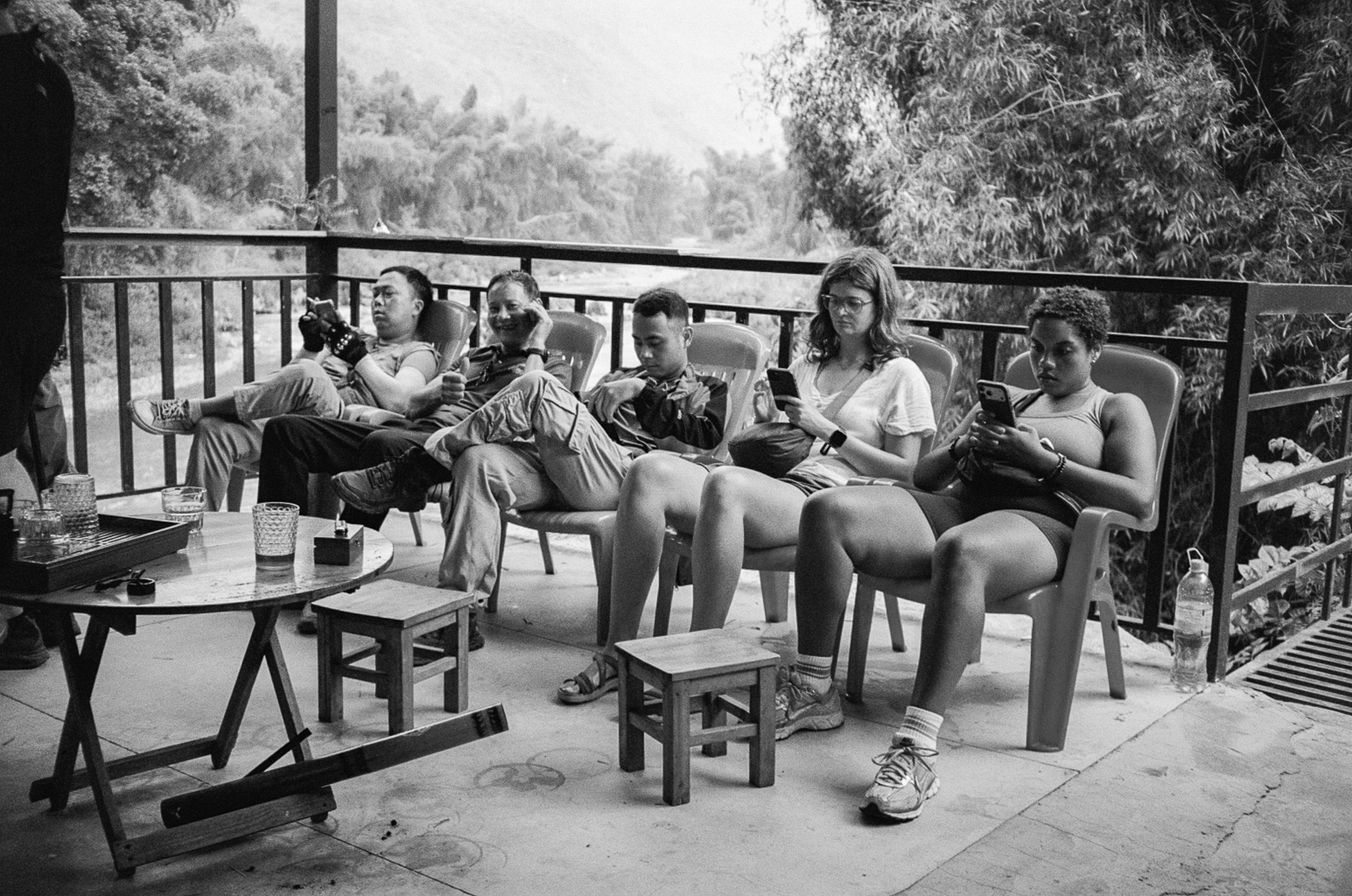
You don’t need a porch or a guitar to run your own experiment. You just need one person and your attention.
Somebody once made me feel seen in the middle of a crowd. She came on stage with nothing but a guitar. It took about four minutes.

The Flow Matrix
Close your eyes.
Look back.
Find a moment where you lost track of time.
You were doing something productive.
Maybe you were working.
Maybe you were studying.
Maybe you were alone, editing photos until two in the morning without noticing how much time had passed. Maybe you were completing a problem set with your friends.
Maybe you were a checker at a grocery store on a busy afternoon, your hands finding the produce codes without even thinking, chatting with customers, the line moving. You looked up and your shift was over.
Time flew.
You were locked in.
It was hard but you were up to it.
You left with more energy than you brought.
Your body remembers.
Write it down.
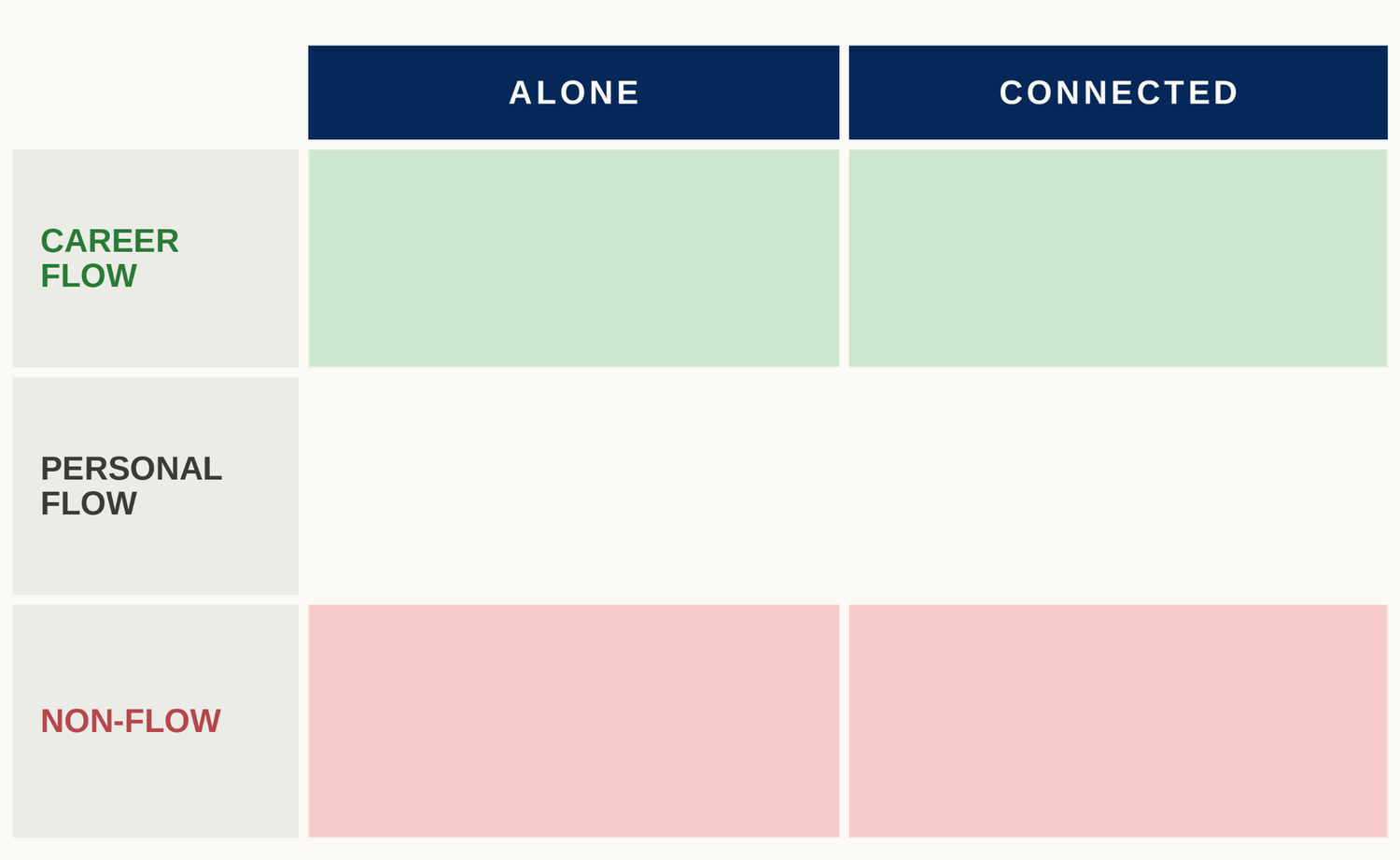
Were you alone, or with people? That’s your column.
The moment goes in your top row.
Your green row. Career Flow. School counts.
Skip the middle for now. Go to the opposite. The hours that drained you. The group project where you did everything and everyone got the credit. My uncle Dave’s whole company riding buses on a Friday night to watch the CEO’s favorite movie. Hanging out where everyone is on their phones in the same room. Together, technically.
Write it down. Alone or with people? Place it.
That’s your bottom row. Your red row. Non-Flow.
Now the row that never shows up on your resume. It feels like the green one, but nobody’s paying you or grading you for it. Some of this row gives back. Music, a hike, a night cooking with friends. Some of it just eats the night. Playing video games. Fine-tuning your fantasy roster. Both live here, and only you know which is which.
Write yours down. You already know the column.
That’s your middle row. No color. Personal Flow.
Notice what you just did. Nobody asked you to list your strengths or circle your values. Nobody asked whether you’re creative or driven or a leader. You looked back and saw the picture your life has already drawn.
The matrix asked for events. Things that actually happened. You didn’t judge yourself. You witnessed yourself. That’s why it works.
The Flow Matrix doesn’t ask whether you should major in film. It asks whether making films puts you in flow. Those are different questions, and the second one is yours to answer, no one else’s.
Here’s my actual matrix.
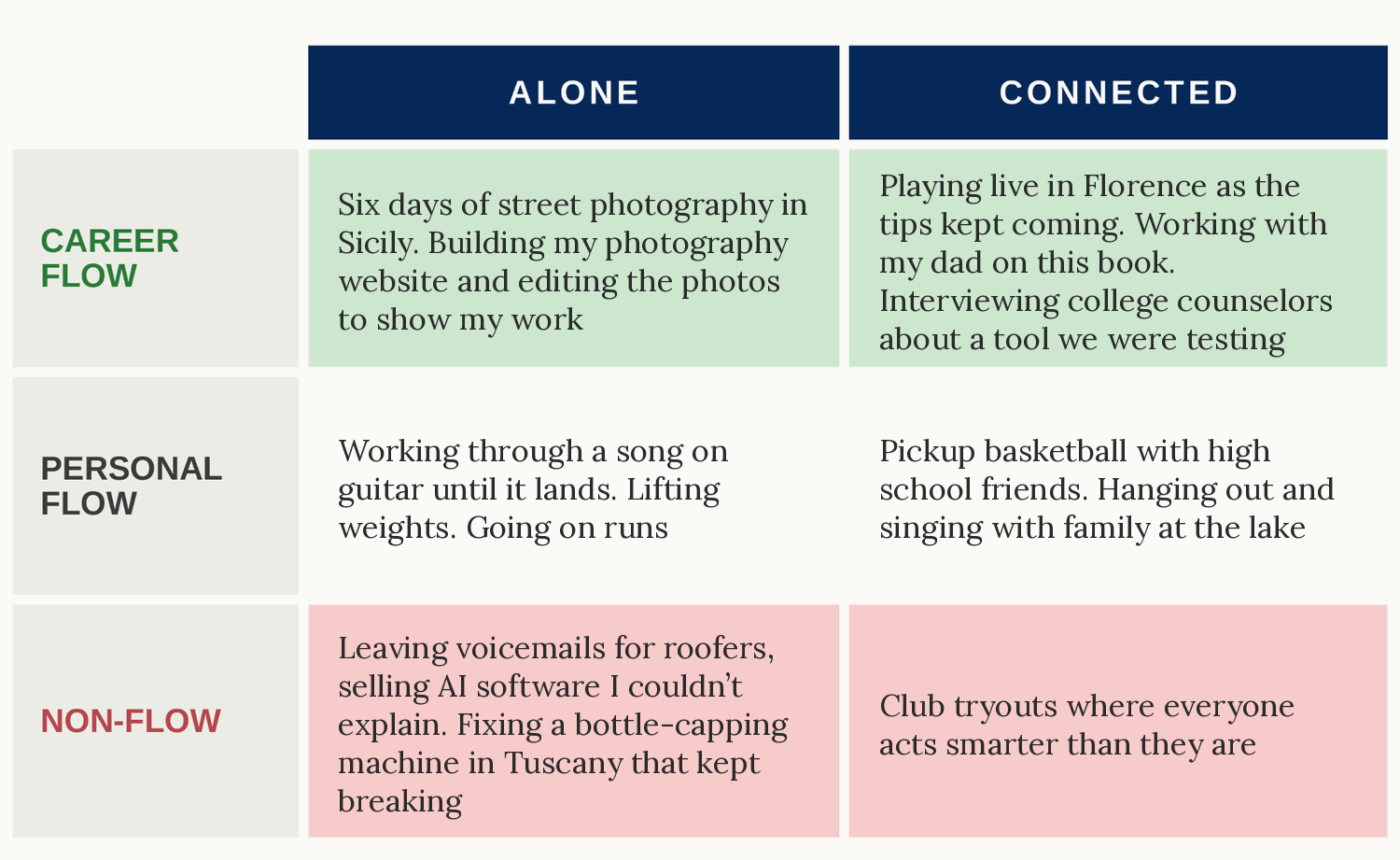
Here’s what my dad noticed when I showed him mine, and it changed how I read the whole chart. Look at the columns, not just the rows. Alone and Connected. Everyone fills this out looking for what they love. But the columns are asking a different question: when you’re at your best, who is with you?
My best cells, the ones where I’m most alive, are in flow and connected. Playing for tips in Florence. Interviewing college counselors. Working on this book with my dad. My worst hours, the ones that leave me emptier than they found me, are almost all alone: at a screen, or at a machine that won’t stop breaking. I have a psychology degree. I know the literature on this. My chart still looked like that. Knowing isn’t the same as seeing your own week sorted into boxes.
The experiment in this book isn’t complicated. Less red. More green. Toby’s best hours all had people in them, so check your columns too. Move one hour from red to green this week and watch what it does to the dot you drew in Chapter 2. Those hours are your 20s.
Get the Full Preview
You’ve just read four of the nine chapters. The full 2027 Preview Edition is a free 75-page PDF.
4. The Bouncing Ball
5. Where Are the Parents
7. Jazz Camp
8. Lizzie’s Question
9. The Box
Plus Walking In With Your Story, Not on the Menu, five more exercises, and the Notes for every chapter.
Email Toby for the full preview
Free. Write to toby@startwithyou.ai and he’ll send you the PDF.
Get Off the Bench
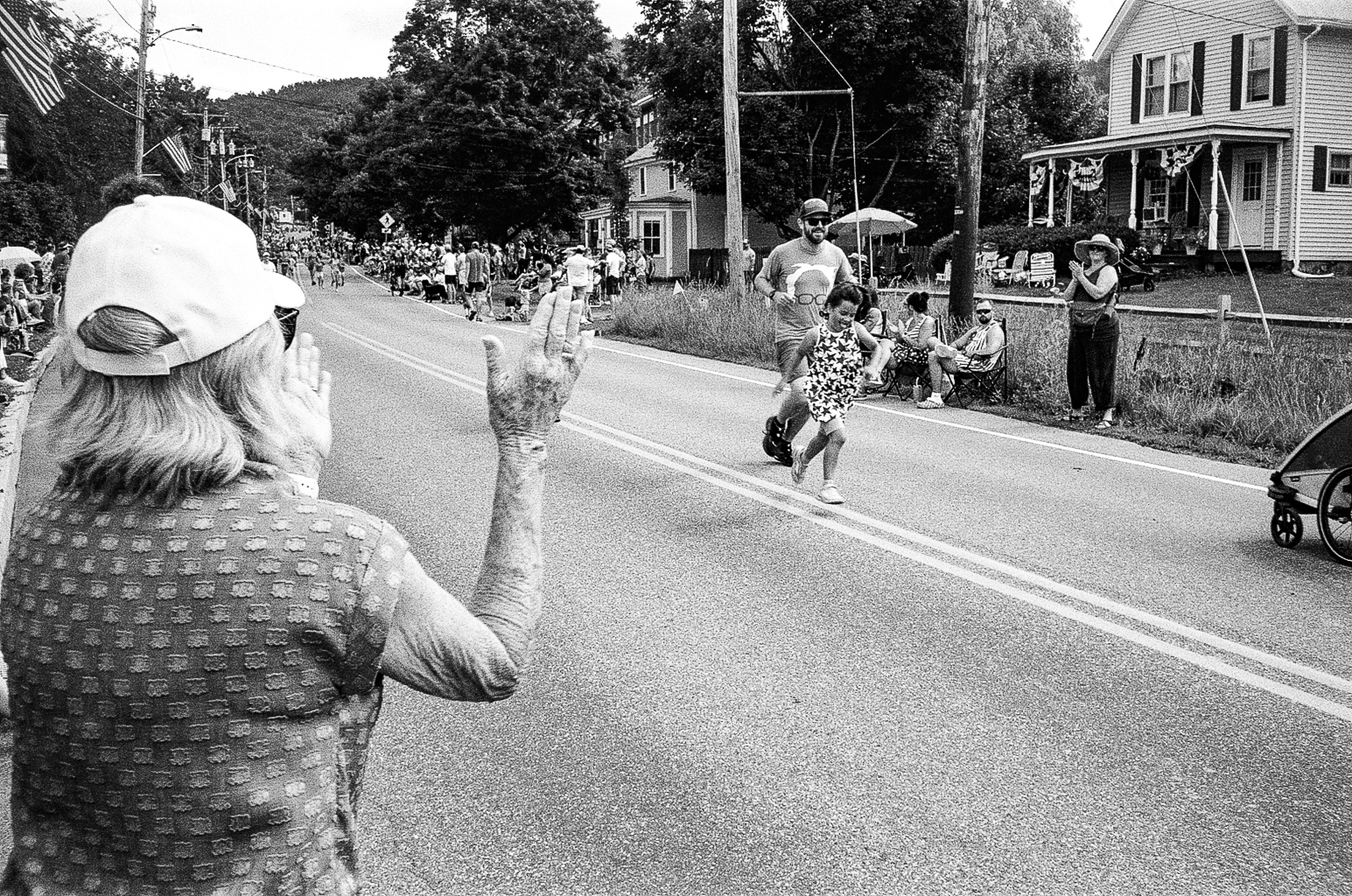
Start giving them your attention.
This page is for the parent in the stands. I’ve been him.
I pushed Lizzie toward club soccer. She was good, maybe too good for rec, and I wanted to give her the best coaching I could find. It took the joy right out of it. She liked rec: the slower pace, games close to home, her friends from town. She didn’t want a better coach. She wanted me to be her coach.
By middle school her friends were too busy to just come over. There had to be a plan.
Lizzie: “What about just playing?”
Nobody had a good answer.
I still don’t have one. I do know what I’d do differently.
This book talks to your kid. This page talks to you. Five things you can do, one for each part of the book.
Part One. The graph moved. Retire “these are the best years of your life.” It was true for us. It isn’t for them. When they tell you something, let them finish. Twenty minutes if it takes twenty minutes. You don’t need anything from them. You need to see them.
Part Two. What they want. Show up to one of their games, whatever their game is now. Don’t keep score. Afterward, instead of “good job,” tell them one thing only a person who was watching could have seen.
Part Three. What they bring. Tell them one thing they do that most people can’t. Don’t give them a label like “creative” or “a leader.” Tell them the moment you saw it, last month or when they were 6. Their strengths showed up long before they had words for them, and you were there.
Part Four. What they can do. Judge the decision, not the outcome. When something they chose goes wrong, ask them two things: what they knew when they chose it, and what mattered to them. If the answers are good, say so, in front of whoever is only looking at the score: Good decision. Bad luck. Ask the same two things when it goes right. Luck feels like skill until it runs out.
Part Five. Do it. Ask them what they’d do if nobody paid them. Then say nothing for a full minute. Then answer it yourself, out loud. If your answer is “what I do now,” tell them. If it isn’t, they just learned something about you, and that’s the point.
Open the front of this book and write one line on the inside cover. Instead of “good luck,” write one thing you saw them do. Then give it to them.
A 3-year-old once asked me why nobody was helping. The adults were right there, a few feet away. The bench is full of us. This page is how you get off it.
About the Authors
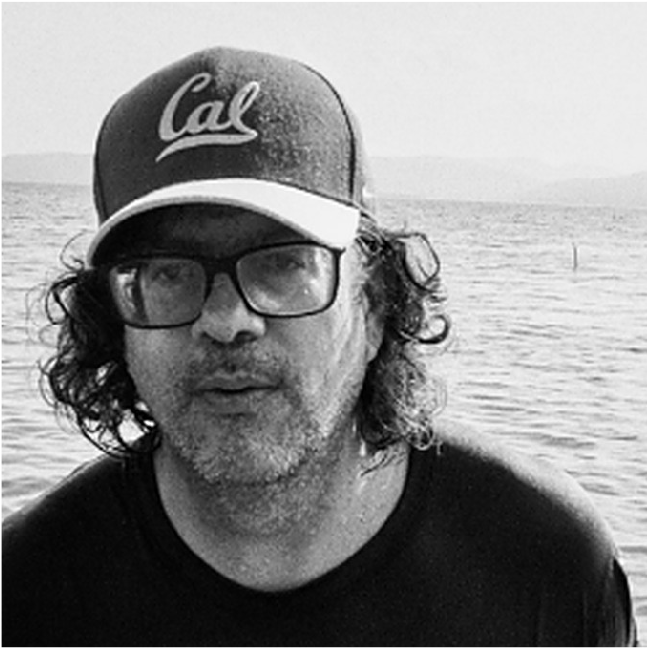
Ben Lamorte is the founder of OKRs.com and the creator of the Identity Blueprint. He has coached leaders at more than two hundred organizations in about twenty countries, and he is the author of Start with You and two previous books on goal setting. He lives in Northern California, plays the piano, and no longer backs out of rooms.
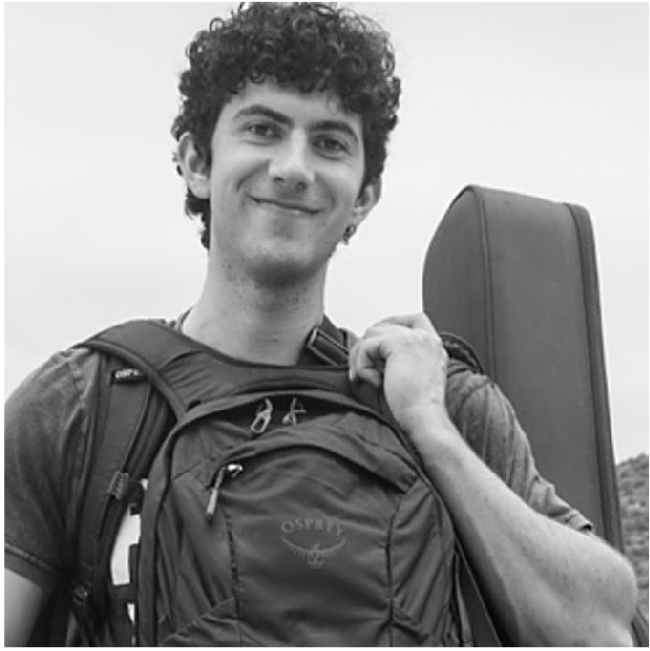
Toby Lamorte graduated from the University of California, Berkeley, with a degree in psychology. He is a musician and a photographer, currently prototyping across several continents. The photographs in this book are his, except where noted. He would like the record to show that his dad really does say beautiful too many times.
Tell Us
This copy is going to a small group of readers before the workshop edition is locked. You’re one of them. We want to know three things by December 13:
1. Where did you stop reading?
2. What felt off?
3. Which exercise did you actually do?
In your 20s? Send it to Toby at toby@startwithyou.ai. If you want to talk more about the project, find Toby Lamorte on LinkedIn.
A parent of someone in their 20s? Write to Ben at ben@startwithyou.ai, or find Ben Lamorte on LinkedIn.
startwithyou.ai/20s