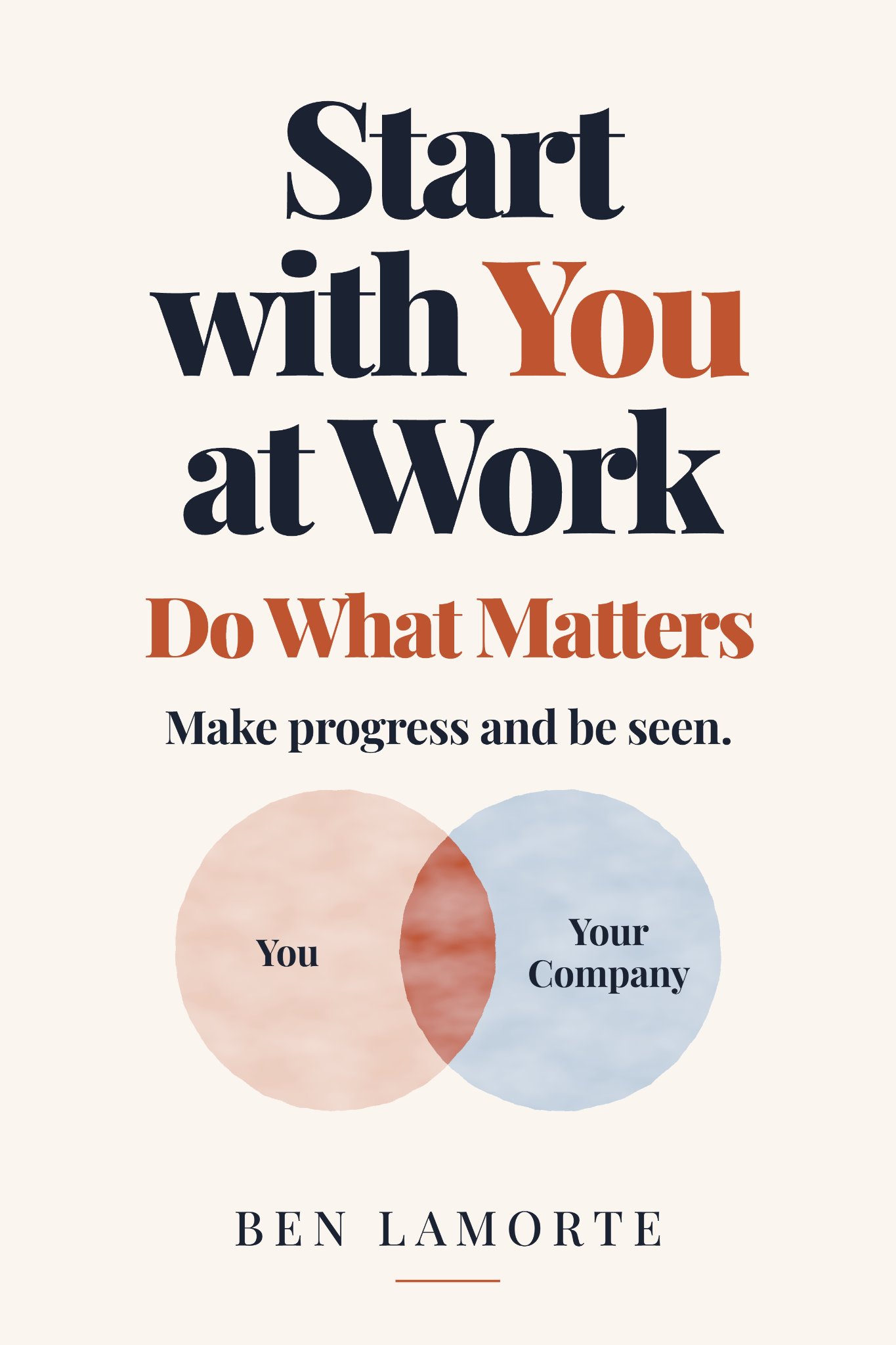
Start with You at Work
Assume AI can take part of your work. It can’t take your why.
Your company hands you a menu of work. This book is about finding where
you and that work overlap and proposing the work nobody offered you.
Grab a piece of paper. It starts with one circle and your name in the middle.
Start readingFor the head of security and everyone who was told their work didn’t connect to the strategy.
Draw Your Circles
What work will you take on this week? What will you say no to?
You’ve been making that choice every week for years. You just haven’t been making it on purpose.
Before you read on, see how you’ve been making it. Do this by feel. Five minutes, no wrong answers. Your name in the middle, then:
- Think of three projects coming up in the next couple of weeks. Draw a circle for each one, big ones big, small ones small, sized by the time they will take.
- If the work feels like yours, overlap it. If it doesn’t, put it far away. Go with your gut.
- Shade wherever a circle overlaps you. Most of them may not. That’s fine. That is your work, as best you can see it today.
I opened a Special Olympics Maryland workshop with this exercise. I asked them to label the circle You. One woman wrote You, crossed it out, wrote Me, crossed that out, and wrote her own name. Here’s her congruence page.
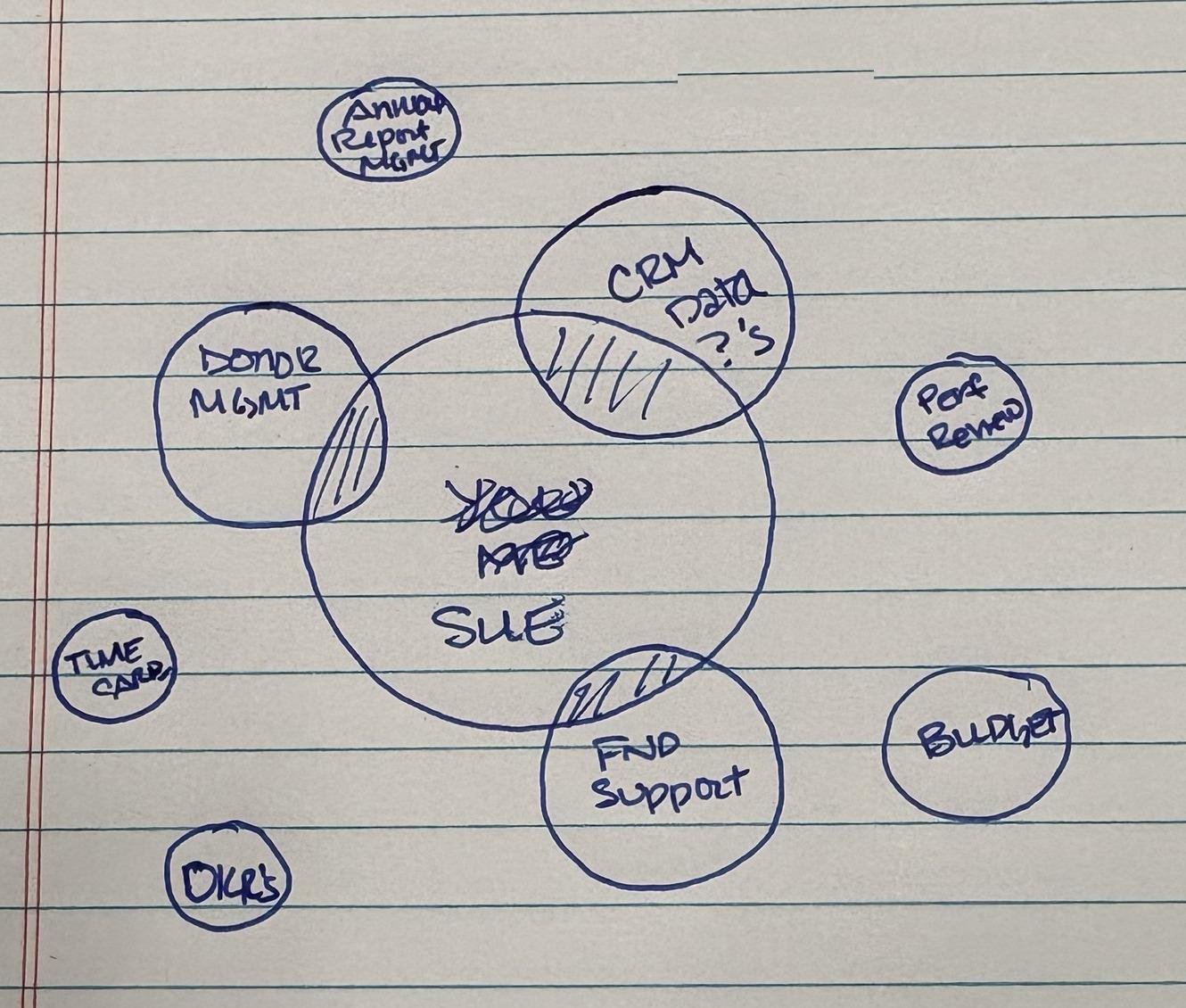
Sue works in fundraising. She drew eight circles. Donor management, fund support, and the CRM data questions overlap her. The annual report, the budget, the timecard, and the performance review sit outside. So do OKRs. I’m fine with that. The workshop I was running that day sat outside her circle. Nobody had asked her before. Now we both knew where her energy wasn’t.
You only need three. Keep your page. Leg One of the book starts with it, and I’d love a photo.
Preface
We were at a leadership retreat, every department of the company in one room. We had spent the day in a workshop on Objectives and Key Results (OKRs), a way of setting goals where each team says what it wants to achieve and how it will measure progress. At the end, each team would present theirs to all the others.
Before his turn, the head of security pulled me aside.
Head of Security: They won’t listen to me. They don’t think security matters. It’s not connected to the strategy. Even the CEO will probably tune me out.
Me: You have some pretty good OKRs. I’m sure they’ll listen. Just try to keep it under ten minutes.
Then I watched him present.
Every person in that room was somewhere else. Laptops. Looking away. The CEO checked his watch. The head of security had predicted it. It happened exactly as he said.
Afterward I told him he was right. I felt sorry for him.
I moved on with my life.
That was years ago, and I still think about him. Something in me knew it was wrong. I didn’t listen to it for a long time.
Carl Rogers, the psychologist, spent his career studying the true self. He called the gap between the self you are and the self you perform incongruence. The gap is what makes people suffer, not their circumstances. Stay in the costume long enough and the suffering shows up in your body.
A company has a true self and a performed self too. A company that lets a whole room turn away from the person protecting it has a gap between what it claims to be and what it is. Incongruence at company scale. Nobody in that room saw the head of security as a person.
This book is written for everyone in that room, and for everyone who was not invited.
If you were told your work is business as usual, not strategic, and does not contribute to the objectives, it is time you were seen. If your work will not pay off for three years and nobody can fit it into a ninety-day goal, it is time you were seen. If you hit every number and they see the number, not you, it is time you were seen.
I’ve spent more than a decade doing nothing but OKR coaching. After all of it, I noticed something. It was never about the OKR itself. It was never about how to connect this OKR to that OKR, or how to report them, or how to load them into a software system. The part that worked was the part that connected people. It let them see why their work mattered, not just to the company, but to them.
That part was rare. Somewhere in the cascade down into the organization, the ownership was gone. OKRs often helped the company. They rarely helped the people in it.
I told clients not to cascade. But they paid me to help them do it anyway. I agreed to try one level, a pilot with a few teams. It worked well enough that nobody asked the harder question, and I kept the contract. When I finally stopped taking that work, I questioned whether I was still doing what mattered. I nearly left the profession.
So I built something that starts with the person instead. I called it the Identity Blueprint. It gets you clear on who you are before anyone hands you a goal.
Then I watched what people did once they were clear. Some left their companies. But many stayed where they were, and the way they changed their approach to their work led me to write this book.
They stopped waiting for work that fit. They looked at what the company needed, found the places where it overlapped with who they are, and proposed that work upward.
More often than I expected, the company said yes.
Near the end of writing this book, I saw that the questions I was asking go one layer deeper than the ones managers are trained to ask. Past the work, to the person doing it. If you manage people, ask yourself the questions in this book first. Then ask your team.
The moment you say no to work that was never yours. The moment you claim the work where you and the company overlap. No matter how small.
You start with you.
Introduction
He was driving a customer’s car back to the shop. It was raining. He pulled into the right lane. The truck behind him swerved. He watched it in the mirror, a blur, and then it crashed into a pole. He would never know if his lane change caused it. That was the whole problem. He kept driving. Back at the shop, another worker told him:
“Don’t worry, that kind of thing happens all the time.”
He went home and talked with his dad. His dad didn’t tell him what to do. He asked one question:
“Can you live with not knowing?”
That night he drove to the police station and told them what happened. The officer said:
“Why are you telling me this? Don’t you know we have to open an investigation?”
He is a CEO now. He told me that story forty years after it happened, and he could still feel it in his body. How could I live with myself, he said, wondering if that truck driver was OK?
Nobody made him go. He went because he could not be one person in that car and another person at home.
He hired me to help set up OKRs. At the workshop where his leadership team drafted them, one was less about the company than about him: working more on the business than in it. So we set it aside for a one-on-one. He did the Identity Blueprint first. The police station story came out of that conversation.
He read the report twice. At our next call, before we got to any of it, he stopped mid-sentence:
“I’m just going to grab my door.”
He got up, closed it, and came back closer to the screen:
“I don’t want to run this company, Ben.”
He wrote one goal for himself that quarter: find the person who would, and get out of the way.
As CEO, he got to choose his goals, but the work was no longer his.
You don’t get to choose most of what you work on. Leadership sets the strategy and sends the goals down. The goals aren’t wrong. They just didn’t start with you.
This book flips it. Your goals begin with what matters to you. Then you find the ones that also matter to the business. Your company may run OKRs, KPIs, or a plan on a page. It makes no difference.
You find the work that’s yours. You put your name on one outcome. You get it in front of someone who can see it, and see you. Give it 120 days.
The first Start with You was about finding your direction, which can take months or years. This one is about the job you have now, and what you do differently next week.
There’s a reason it’s next week and not someday. I’ve been in the rooms where companies decide what AI is for. Nobody says jobs. They say productivity, which means the same work with fewer people. This time those people sit at desks. They read books like this one.
Assume AI can take part of your work. It can’t take your why.
You’ve been told your company’s why. What if your company knew yours?
What if you made the part of your work that is yours bigger?
Some of you move from work you detest to work you can tolerate.
Some of you move from work you can tolerate to work you like.
Some of you move from work you like to work that is yours.
Do what matters. Make progress. Be seen.
You
Only you can do the part that’s left.
You Are Human. Use It.
I’m starting a company. I don’t have a boss.
So it took me a while to notice I was taking orders.
I asked AI to help with my website. It told me what to build next, and I built it. Copy. Paste. Before I knew it, my website had ten pages, each with its own content and visuals.
Then I stopped.
Why am I building so many pages? I was letting AI boss me around.
I could say stop. Some people never get the chance.
A bank cut 137 jobs. Most of the people were there twenty years or more. Picture one of them. She started at twenty-two. She knows the systems inside out, and she doesn’t know anything else. Her daughter has three years of school left. Who hires someone with twenty-five years of experience doing only one thing?
The work is going to two outside firms. Both sell AI.
They were good at their jobs. Many liked the work. It didn’t save them.
Liking your work and owning it are not the same thing.
I should know. I was one of those students who always asked what would be on the test. Nobody ever asked me what I wanted to learn. Work was the next test. For eight years I was the spreadsheet guy. Someone needed a model. I built it. I was rewarded. I never asked whether the work was mine. Being good at it was enough.
It’s not enough anymore. Spreadsheets are a prompt now. So are meeting notes, the clean status report, and the dashboard built from twenty-five metrics. Nobody doing that work did anything wrong. Their work got cheap.
The question isn’t whether AI takes your job. It’s which part of your job it’s coming for. This isn’t a book about how to use AI.
Tony ran IT. Every one of his team’s four key results that quarter was about AI. Update this tool. Turn off that one. Roll out the new one. Get more use cases. He missed all four. There were eight of us on the call.
Me: What did you learn?
Tony: We didn’t make progress. People don’t understand the value.
Me: I don’t either. Why is this important?
He talked for a while. The competitors were using AI. Everyone needed to catch up.
Me: Is this AI for our customers, or for us?
Tony: For us. Our employees.
Me: Then why do I care?
Tony: Because our competitors are winning deals.
Me: Why are they winning?
Tony: They get their proposals to customers faster. They use AI to do it. We don’t.
Me: Everybody stop. Write that down.
They spent a quarter figuring out how to use AI. Nobody asked what it was for. Nobody owned an outcome. They started with AI instead of starting with themselves.
The moment Tony said proposals, the energy changed. Until then he was one of eight names on a screen. Now he was Tony.
We stopped reviewing goals. Tony and the VP of Sales wrote one key result together, and both of their names went on it: Cut the time to get a proposal to a customer from five days to one.
Four tasks about AI became one outcome about customers. Nothing in the key result says AI. Tony’s team will use AI to get there, and everyone knows why.
AI could have found the fact that stopped the meeting. It could have said it better. It had nothing at stake. Tony had to stand behind it. He had something at stake, and we felt it. That is resonance. It’s your advantage over AI.
Look at that call again.
For a quarter, Tony’s team worked through someone else’s list and produced updates anyone could produce. AI can do both.
Then three things happened in minutes. Two names went on a single outcome. Everyone on that call could point to what it would change for a customer. One of eight names on a screen became Tony.
AI wins two. You win four.
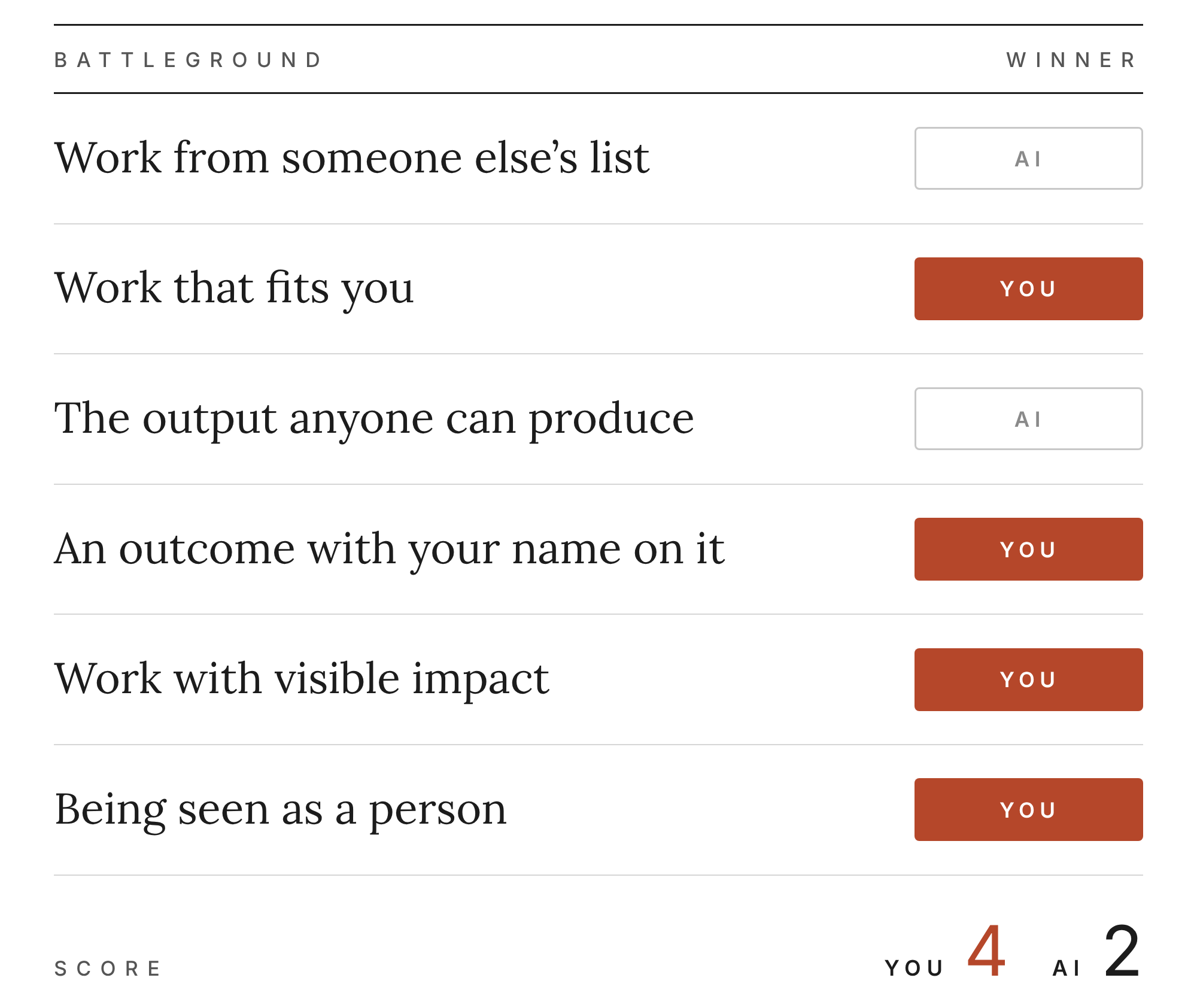
The score isn’t a forecast. It’s a map of where you have the advantage.
The two AI wins were never about you: working through a list someone else wrote, and producing output anyone could produce. Tony’s team spent a quarter there. The people at the bank spent twenty years there, and they were good at it. So was I. We were all fighting on the wrong ground. Don’t make it your game.
Nobody asked them about the other four. Nobody asked me either, for most of my career. Your company studied its customers, its competitors, and its market. It never studied you.
The four you win start with you. Work that fits you. An outcome with your name on it. Work with visible impact. Being seen as a person. For most of my career, those were nice-to-haves. Now, they’re the job.
Knowing yourself used to be optional. You could get through a career without it. I nearly did.
AI can produce the output. It can propose an outcome. It can’t put a name on it. You can comply with any goal. Only you can commit to one and own it.
AI can write your weekly status report. It can even grade it:
“Your report is up from 8.4 to 9.2. Send it.”
That’s praise from nobody. Only a person can see you. Only you can see the person in front of you.
I can’t promise the four will save your job. Nobody can.
They’re the only ground where you’re winning.
Stop asking how to use AI. Start asking what only you can do.
You are human. Use it.
Where is your energy going?
Your Menu
You order a salad. The waiter asks what dressing you want.
You: What are the choices?
Waiter: Balsamic, blue cheese, or Italian.
You: Italian, I guess.
That felt like a decision. You picked from someone else’s list.
Now try it this way.
Waiter: What dressing would you like?
You: Oil and vinegar. On the side.
This time he never got to read you the list. You already knew what you wanted.
The first way is alternative-focused: you can’t decide until someone gives you options. The second is value-focused: you start with what matters to you.
At work, somebody always has a list.
Choosing from the company’s list feels normal because you’ve done it your whole life. Pick a class. Pick a major. Pick from the companies that came to campus. Then you got hired, and the lists kept coming.
Picking from a list feels like deciding. It is actually the moment you stop deciding.
Top down, the company hands you the menu. Bottom up, you build your own menu, and the company picks.
Bottom up starts when you go to someone and say: here’s what I propose, here’s why it matters to the company, and here’s why it matters to me. That’s the oil and vinegar. Nobody read you a list. You started with what matters to you.
Most companies run the other way.
I coached a CEO with two thousand people. He read an OKR example about a football team, where the general manager’s goal to make money for the owners cascaded out to every group. The head coach wins the Super Bowl. PR fills the stands. Everybody had a goal that traced back to the top. His leadership team built the company’s goals the same way and passed them down. The executives were proud of that menu, and they had reason to be. If everyone took their piece and delivered, the company would win.
Then he told me what was wrong.
CEO: We have great OKRs for the company and the three business units. The problem is that most of our hundred managers don’t own their goals. We have no buy-in at the lower levels.
I keep seeing this. Top down is broken. The CEO was unusual. He noticed.
Nothing was wrong with the company’s goals. They were clear, they came with reasons, and his managers took them. The research says that’s enough to motivate a person about as well as a goal they set themselves, and I believe it. He had a hundred motivated managers. A motivated manager works on the goal. An owner fights for it. Motivation doesn’t win the Super Bowl. I can’t prove that. It’s what I saw in more than 200 companies, and it’s the bet this book makes.
When a goal is passed down, nobody can tell whether the person owns it. The CEO gave them a menu. A hundred managers picked. Every one of them said yes. A yes sounds the same whether you mean it or not.
You’ve said that yes. A goal came down with a good reason attached, and you took it. You worked on it. You didn’t fight for it. When something urgent came up, it was the first thing to go.
The best manager I know once told me the secret of management: get the other person to think your idea was theirs. It works, because when the idea is yours, you own it. The manager still can’t tell. Did they take the idea, or did they just go along with it?
What if nobody had to trick anyone? What if the idea started with the person doing the work?
Some work will always come from the top, and some of it should. Your company may never stop handing you a menu. Nobody can stop you from handing them yours.
Are you choosing your work, or picking from someone else’s menu?
Your Wobble
Let me describe your situation, and you tell me how close I get.
You keep something running. A platform, a network, a building, a set of books, a production line, a team that everyone forgets exists until the day it fails. Success in your job looks like nothing happening. You’ve gotten so good at it that nothing ever happens, which means nobody ever sees what you do. Last quarter, in a planning meeting, someone looked at your box on the org chart and asked:
“So what does your group really do?”
You had an answer. It didn’t connect to company goals. So you sat there while the conversation moved on, holding an answer with nowhere to put it.
Is that you?
Or maybe you’re building something that won’t pay off this year. A research program. The product line that shows up in stores next year. Every ninety days a planning cycle comes around and someone asks what you’ll deliver by the end of the quarter. You don’t know how to answer that, so you send in the latest roadmap. Your real work doesn’t show up on the slide. You’re left wondering if you’re contributing at all.
Is that you?
Or maybe you’re winning. You were an athlete in school. You love the scoreboard. You joined a big company in sales and you were locked in from day one. The number came down from above with your name already on it. It was the only thing on the menu. You hit it every quarter. You get the commission, the trip, your name at the top of the slide. Nobody doubts you. Then you close the biggest deal of your year, and the feeling is gone before you reach the parking lot. Your number matters to the company. It was never yours. You’re playing someone else’s game. You’re good at it. So you keep going.
Is that you?
Three people. The platform manager nobody sees, the builder on a different timeframe, and the sales rep winning someone else’s game.
Something underneath you isn’t solid. You’re wobbling. Sunday night dread. A shortness of patience you didn’t use to have.
Picture a stool with three legs. It’s holding you up at work.
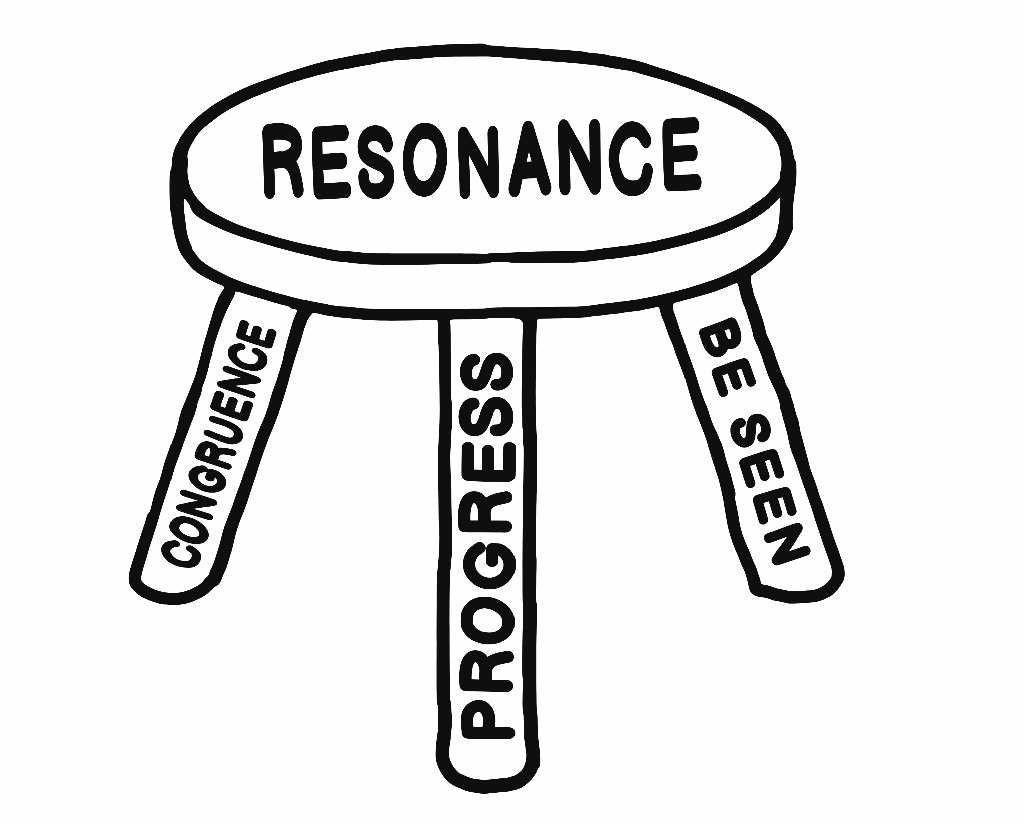
The first leg is congruence: work the company needs that fits you. The second is progress: output that leads to an outcome with your name on it. The third is being seen: impact that’s visible, and someone who sees you as a person, beyond the impact you make.
Each leg has two halves, the six battlegrounds. When both halves are in place, the leg is stable. With one, it’s weak. With neither, it’s missing. The two AI wins are in there too. They’re each half a leg, so you still need them. You just can’t stand on them alone.
You need all three. If one is weak, you wobble. If one is missing, you spend everything you have trying to balance. From the inside, you can’t tell which leg it is. You just feel the wobble. A weak leg costs you in your sleep, your body, the person your family gets at dinner.
When all three legs hold, your work resonates.
People sit on wobbly stools for years. They get skilled at balancing. They look fine from the outside. Looking fine used to be enough.
Maybe your stool isn’t wobbling at all. Maybe you like your job. Many of the people at the bank liked theirs. Liking the work is one half of one leg. Their stool felt stable right up to the morning that leg came out from under it.
You can have a weak leg and not feel it yet.
Which leg is it for you?
Go Where Your Energy Is
When I was a kid, Sunday was our family clean day. My sister and I helped out. I’d find my mom in the kitchen.
Me: Should I start by cleaning my room or doing the dishes?
Mom: Just go where your energy is.
She didn’t care which one I did first. The house was going to get cleaner either way. She cared that I did what felt right to me in the moment.
There’s a saying in my line of work: ideas are easy, execution is everything. It’s true, but most companies do the reverse. A leadership team writing its objectives is the idea. I’ve watched it in more than 200 companies. You can feel the energy when the objectives go up on the wall.
Execution is the months after, done by people who weren’t in the room. It’s the New Year’s resolution problem. You meant it the first week of January. Do you remember it in February?
In a company it happens to a thousand people at once. By the time the goals reach the people doing the work, what arrives is another framework, another thing to get done. As the goals cascade down, the energy drains. So the CEO goes on the road to put it back. A town hall, a video, a speech about what matters this quarter. It works for about a day. You can’t keep a fire going by squirting more lighter fluid on it. You need wood. People already have it: the work they’d do without being told, if anyone asked them what it was.
Every goal asks someone to do something differently. Behavior doesn’t change because someone was told to change it, or because an email explained why the company needs it. It changes when the person has the energy to change it.
You can cascade a goal.
You can’t cascade energy.

The OKR world has one word for what it’s after: alignment. It has always meant one thing: your work connects to the company’s goals. But alignment has two ingredients. Nobody checked the second one: work aligned with you.
When only the first is true, the company gets compliance. When both are true, the company is going where its energy is. The house gets cleaner. The goals get executed because the people doing the work chose it.
My mom didn’t call it alignment.
Go where your energy is.
Where the Book Goes Next
You have a page of circles and a stool with three words on it. The book takes it from there, one leg at a time.
Leg One is congruence, and it starts with your circles. You’ll find your fire and your lines: the conditions that make work feel like yours, and the things you won’t do. You’ll learn what it means to do what matters, and you’ll get a number for how much of your work is yours. Then you’ll draw a circle the company never offered and write the one-page proposal for it.
Leg Two is progress. You’ll write one Impact: an outcome with your name on it, written so someone else could check it. Some Impacts improve a number. Some protect a level nobody notices until it drops. Some test a bet nobody has made yet. You’ll set a commit, a target, and a stretch that would be amazing.
Leg Three is the one most of us skip. Your impact becomes visible, and someone sees you as a person, beyond the work.
The book ends on The Ship: your review, your one-on-ones, and a CEO who started with himself.
Three Questions for You
Thank you for reading. Short answers are enough. Write to ben@startwithyou.ai.
1. Where did you slow down, stop, or get confused? A chapter or a phrase is enough.
2. What stuck with you most?
3. If you drew your circles, send me a photo of the page.
— Ben
Sources
The full book has proper notes. These are the ones a reader of this preview is most likely to want.
Carl Rogers on congruence and the gap between the self you are and the self you perform, in On Becoming a Person (1961). Preface.
Cory Doctorow on the reverse centaur, “a human who is conscripted into acting as an assistant to a machine,” in The Reverse Centaur’s Guide to Life After AI (Farrar, Straus and Giroux, 2026). Chapter 1.
The bank worker in Chapter 1 is a composite. The figures are from Matthew Ward Agius and Sharne Wakefield, “Adelaide workers expected to be most affected by Bendigo and Adelaide Bank cuts,” ABC News, September 18, 2026.
Ralph Keeney on alternative-focused and value-focused thinking, in Value-Focused Thinking: A Path to Creative Decisionmaking (Harvard University Press, 1992). Chapter 2.
John Doerr’s football team, the example that led to the widespread adoption of cascading OKRs, and the line “Ideas are easy. Execution is everything,” in Measure What Matters (Portfolio, 2018). Chapter 2 and the Interlude.
Edwin Locke and Gary Latham on assigned goals that come with a clear reason motivating about as well as goals people set themselves, in “Building a Practically Useful Theory of Goal Setting and Task Motivation,” American Psychologist 57, no. 9 (2002). Chapter 2.
With Thanks
This preview exists because these people let me start with them.
Jim Schmutz, CEO of Special Olympics Maryland, said yes before there was a book and opened his team to it.
Renae Fisher, who co-coaches the Special Olympics Maryland work with me.
Sue Jacobs, for the page she drew around her own name. It opens this preview.
Karin Marcus, whose feedback shaped the book, including the rule of one Impact per person.
Ana Venosa, who built the Outcome Mindset with me.
Dan Lee, for the biweekly calls and for a story the finished book will tell.
Christina Wodtke, whose view on cascading runs through this book.
Paul Niven, who taught me how to write a book.
Peter Kerr, author of Earn the Right and one of the first to complete the Blueprint, whose question, why do I care and why now, is the reason the opening section exists.
Chirag Panjikar, a skeptic of assessments who became the Blueprint’s first true believer and told me you don’t give someone half a point, which is why this is one book and not two.
Andy Dvaretski, for helping me bring the Blueprint into OKRs.
Manos Koumantakis, founder of altoValue, who encouraged me to write The OKRs Field Book and whose team is shaping how this work meets the world.
Tom Hartman, one of my early readers, whose detailed feedback found what I couldn’t see from inside the draft.
My team, Gerri Vereen, Catherine Chen, and Mandy Hill, who keep everything else running while I write.
The full acknowledgments come with the finished book.
About the Author

Ben Lamorte is the founder of OKRs.com and the author of Objectives and Key Results (Wiley, 2016, with Paul Niven) and The OKRs Field Book (Wiley, 2022). He has coached leadership teams at more than 200 organizations in about twenty countries. He studied decision analysis at Stanford under Ronald Howard. In 2026 he built the Identity Blueprint and wrote Start with You: Go Beyond Prototyping. Get Clarity Before You Commit, the book this one stands on. He lives in Northern California. Reach him at ben@startwithyou.ai, and take the Blueprint at startwithyou.ai.
Copyright © 2026 by Ben Lamorte. All rights reserved.
startwithyou.ai