Start with You
You make your biggest decisions the way you order at a restaurant.
You look at the roles posted, the paths approved, the choices everyone else seems to be making. You pick from that list. Picking from it feels like deciding. It is actually the moment you stop deciding.
“Ben’s framework doesn’t give you answers, it challenges you to examine the evidence of your own life.” —Paul R. Niven, author of OKRs For DummiesStart reading Get the book
Prospective Readers
This book is only a door. It makes no promises. Start with You takes you from where you are to the threshold.
If you cannot see the door in front of you, your own words can reveal it.
The bigger the door, the bigger the commitment.
If you do not yet have clarity, you go through little doors with a question. You prototype.
If you already have clarity, you go through the Big Door as yourself and discover how the world responds. You are beyond prototyping. You assert your true self into the world.
Your door may lead somewhere new. It may take you deeper into the life that is already yours.
Bring a pen. You will write in this book.
Preface
You make your biggest decisions the way you order at a restaurant.
You look at the roles posted, the paths approved, the choices everyone else seems to be making. You pick from that list. Picking from it feels like deciding. It is actually the moment you stop deciding.
The menu is the world’s answer to a question you stopped asking: Who are you?
I know, because it happened to me one small choice at a time, while the world applauded. I was fifty-two, successful, with no idea what to do next.
Companies pay me for clarity. I work with leadership teams for two days. When I leave, they know what matters and how to measure it. Two hundred organizations. Two books about the method. I start with the strategy, the market, the numbers. I had never started with the person.
So I became my own client.
The tools were already in my hands. At Stanford, Professor Ron Howard taught me that any clear decision rests on a three-leg stool: what you know, what you value, and what you can actually do. The stool had become a decoration on my business card. I had never used it on myself.
You have lived under both kinds of advice. The old advice told you to look inward. You did the looking but never moved. The new advice made a correction: You cannot think your way into a better life. You must do something. Try things. Prototype.
Prototyping works. We just never knew how to end it.
We treated it as the whole answer. Start with action. Looking inward became an afterthought. Even our language turned outward. Prototype. Iterate. Somewhere along the way you started treating yourself like a product. Versioned. Measured by what sells.
A product exists to be approved. You exist to be expressed.
What if you treated yourself like you instead of a product?
You do not need approval. You need to be seen.
The menu and the product are the same mistake. One tells you what to pick. The other tells you what to become. Neither starts with you.
Maybe you are prototyping without a question. You are drifting.
Maybe you got your answer. Your door is in front of you, but you are not walking through it. Maybe you are just picking from the menu and calling it a decision.
To go beyond prototyping, you must know yourself. Knowing yourself is not as hard as you have been told. The evidence is already there.
I ran the same experiment with one hundred people: clients, coaches, students. I asked for their stories and read them back. Clarity came for nearly everyone, and faster than I expected. Where it sent them, I could not predict. Some changed companies. Some created work that did not exist. Others stayed and made the work their own.
I wrote this book so you can understand yourself and bring that self into the world. It gives you the instruments. Your life supplies the data.
It does not offer permanent enlightenment. It offers moments you cannot argue with. You feel it in your body. It can wake you up in a way no advice ever will.
Inside you is a self waiting to be expressed. Without expression, your life succeeds on someone else’s terms. It never quite feels like yours.
To start with you, in a world that hands you a menu, may be the most difficult thing you ever do. It may also be the most important. Whatever success or failure comes, it belongs to you.
My experiment ended. I got clarity. I committed. This book is my door. I walked through it.
Yours is in front of you.
Introduction
This book does not start with me. It does not start with my clients. It starts with you.
You will hear my story. Treat it as a mirror, a way to see your own life more clearly. You will meet my clients, who speak in these pages in their own words. Treat them as mirrors too. Every story in this book exists for one purpose: to help you see the picture your life has already drawn.
You may have found this book through the Identity Blueprint, a tool I built to read your stories back to you. The Draft Report is free at startwithyou.ai. You do not need it to use this book. The questions are the instrument, and every one of them is in these pages.
You have seen the books that ask: Are you a leader? What are your top five strengths? Circle the values that matter most to you. We do not do that here. A list asks for your opinion of yourself. This book asks for your evidence.
You and I are going to be detectives. We will go back through your life together. The evidence of who you are is already there.
It is in the work that makes you lose track of time.
It is in what your body does under conditions that violate your values.
It is in the seed you planted years ago and gave up on when the world saw no use for it, still waiting in the ground.
Our work is to find it.
This book needs you to write in it. By the end, you will not be holding my framework. You will be holding a picture of yourself, drawn from your own stories, in your own words.
Start with you.
You
I don’t care about them.
I care about you.
How to Start with You
Most advice starts with a framework. But what happens when the framework is you?
Close your eyes.
Look back.
Find a moment you lost track of time while you were working.
Maybe you were alone, building a marketing plan.
Maybe you were with other people, at a whiteboard.
Time flew by.
You felt focused.
You were challenged.
You left energized.
You know exactly what it was.
Your body remembers.
That is the seed of the work you love.
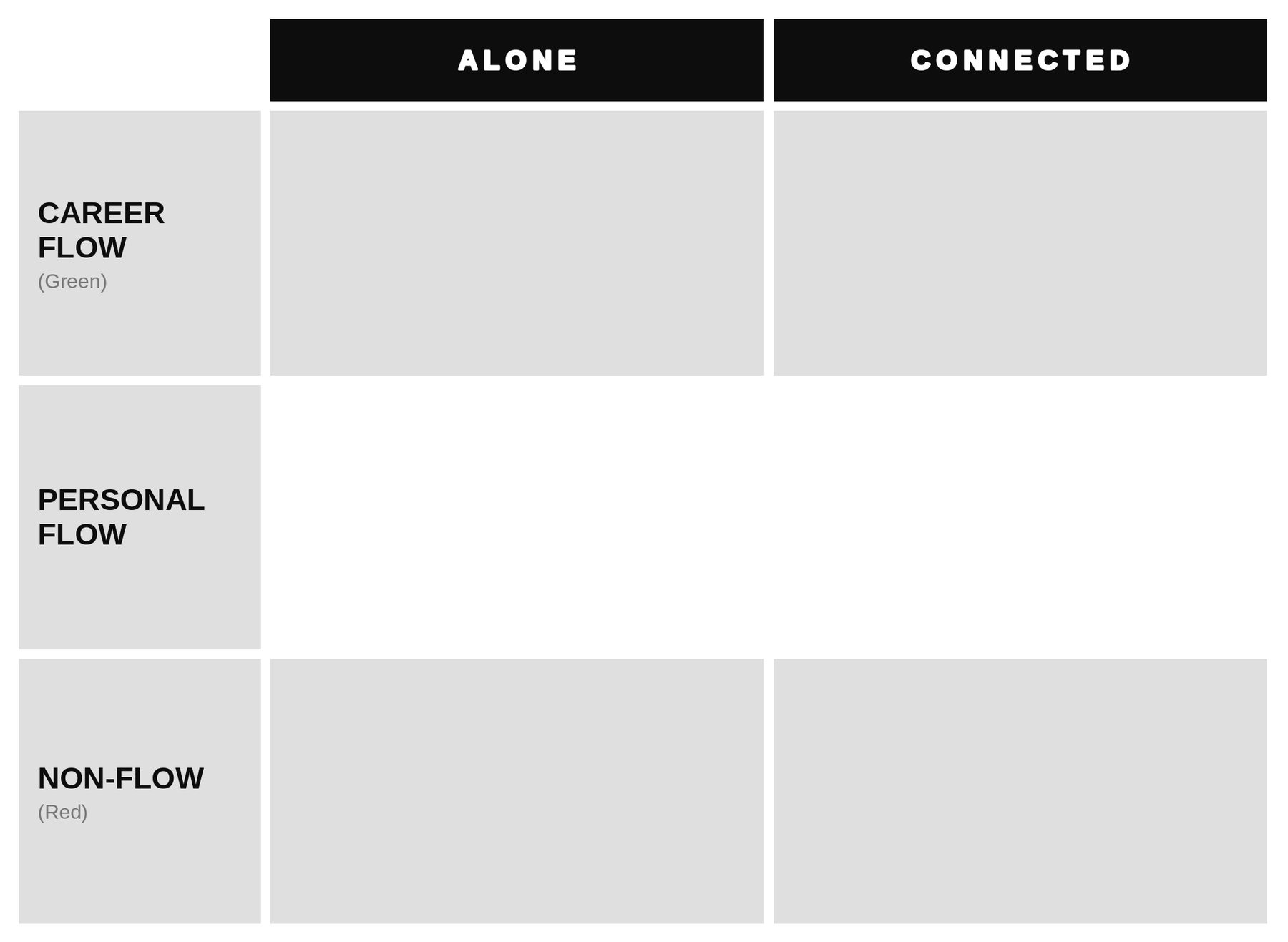
Were you alone, or connected?
That is the top row.
Your green row. Career Flow.
Write it down in your matrix.
Now for the row that holds the rest of your flow.
Time flies here too.
You are challenged.
But it does nothing for your career.
Maybe you were rock climbing at the edge of what you thought was possible.
Maybe you were writing a screenplay nobody asked for.
Write yours down. Alone or connected?
That is your middle row. Personal Flow.
Now think of an activity that drained you.
Maybe it was meeting with your accountant to prepare your taxes. You watched the clock. Wait, maybe you love meeting with your accountant. I do not know your life. You do.
Maybe it drained you, and you lost track of time anyway.
Maybe it was online shopping.
Maybe it was YouTube videos.
Nothing challenged you.
You left empty.
That is the dangerous one.
Write yours down.
That is your bottom row.
Your red row. Non-Flow.
Notice what you just did.
Most tools start with a list. A list asks for your opinion of yourself: Am I creative? Is integrity one of my values? Am I a good leader?
The Flow Matrix asked you for an event. When did you lose track of time? Something concrete that happened, that landed in your body as a fact.
You are an unreliable judge of your own character. But you are a reliable witness of your own experience.
That is what happens when the framework is you: The answers come from your life, and nowhere else.
Your strengths might surface from the green row.
Your values might show up in the red row.
Your directions might emerge from the work that moves you into the green and out of the red.
The moment you put that first thing into your Flow Matrix.
No matter what it was.
No matter where you put it.
You started with you.
Are You Starting with You?
You just ordered a salad. The waiter reads you the options: blue cheese, ranch, Italian, balsamic.
That is the menu.
You pick one.
Is this how you make the most important decisions of your life?
What if you started with you instead?
Fari’s Smile
In my mid-twenties I was engaged to be married, working eighty-hour weeks, carrying a work identity I had not chosen. On Church Street in Vermont, my future father-in-law, Fari Amini, told me he loved his work:
When you love your work, you never work a day in your life.
He was smiling when he said it. Not the polite smile of someone repeating a familiar phrase. Fari had the glowing smile of a man who was, in that moment, inside the experience he was describing.
Part of me wanted to punch him. Work is the stuff you do so you can afford time with the people you love. He sounded like a man rationalizing a life given to his career. He was not rationalizing. He had started with himself. I had started with a menu.
Lizzie’s Question
Lizzie was six when she answered my question with a better one.
Me: What do you want to be when you grow up?
Lizzie: I’m an artist, Dad. Why would I wait until I grow up?
Me: What kind of artist? Music? Poetry? Writing?
Lizzie: All art. Why would I just pick one?
No one could get her to perform a version of herself she had not chosen.
When she started at the traditional high school, there was no room to be herself. Lizzie did not bend to fit it. She left it. She found a school where she could do more art, and the work flourished. Songs, screenplays, poems, and paintings.
She was asserting who she was before life had taught her to postpone it.
Most of us learn to wait.
Years later, on one of our philosophy walks, she asked me a question.
Lizzie: Dad, if you didn’t get paid to do your work, would you go to work tomorrow?
Me: No way.
Lizzie: Well, what would you do instead?
Me: I’m not sure.
Lizzie: But, Dad, you’re fifty-two.
I had no answer for my daughter.
Lizzie had never looked at a menu.
Fari’s Blessing
A year after Church Street, when I married Ariana, Fari stood to give a blessing:
Let beautiful things grow.
Create the conditions, tend them, wait, and something beautiful grows.
It took me years to see how it applies to work. Not in theory. In the body. The right work, grown rather than imposed, can be beautiful too. Now, when I wake up and go to work, like a kid about to play with their best friend, I think of Fari.
That is what I want for you: to feel what Fari felt on Church Street.
What You Now Hold
Three pieces of evidence.
Your flow.
Your fire.
Your line.
Nobody handed them to you.
Nothing labeled you.
These are early sketches. Your strengths and your directions come later, surfaced from your stories.
The people in this book will find their flow, claim their fire, and draw the lines they will not cross. Do not just watch them. Hold your pages next to theirs.
Starting with a menu is one way to fail.
But a menu at least assumes you are a person.
Some of us start with something worse.
Are You Starting with a Number?
I walked into rooms and scanned them.
At events where we were sponsors, everyone seemed to be smiling. Sometimes it was Dreamforce. Sometimes it was a networking event. I was also smiling.
I would scan the room for the next lead. When I found someone with the right job title, I would turn on the charm. I wanted that business card. I looked past anyone who could not move my number.
My boss never asked if I had a single deep conversation.
He asked:
How many leads did you get, how many saw the demo, did you put them in the system?
He needed the number for his boss, who needed it for hers. Somewhere in that chain a person stopped being a person and became a number in the system. I learned to see people that way. I got good at it.
I treated people as leads because I treated myself as one too. I did it for years. I was worth whatever number I brought back. Once you believe that about yourself, you start believing it about everyone.
Why Are We Talking About Them?
Jessica Unholz came to me for coaching:
They are filtering me out. They want twenty years of experience. They want a certification I do not have. The system kicks me out before a human even reads my name.
She had just gotten married. She had savings, close to a year of runway. She had time to be intentional. But she could not see it.
I asked why she was rushing. She had lost her job a few months earlier. She was not solving for what she needed. She was solving for what people she had never met might think of her.
I stopped her:
Why do we keep talking about them? I don’t care about them. I care about you. You have time. Slow down. Talk with the people who know you. Tell them you’re flexible. A three-month project. A part-time role. Little doors.
Jessica and I look like opposites. I was the one scanning the room. She was the one being scanned. But it is the same disease. The world was scoring her, ranking her, filtering her. Slowly she began to believe the picture the world was drawing of her.
A Different Voice
A month after our conversation, Jessica wrote to me in a different voice:
Most of my focus lately has been on communicating my experience more effectively in interviews. I’m finding it’s just as important as understanding the role itself, and your “little door” perspective has stayed with me throughout the process. I have an interview on Wednesday.
Months later she took a job, a role at a company she’d worked for before. This time she went in open about where she stood, and those honest conversations led to more opportunities than the one she’d accepted.
She was starting with herself.
Jessica helped me understand why I wrote this book. I want you to stop seeing yourself through the world’s filters.
Two Ways to Act
There are two ways to start with you. The right one depends on whether you have clarity.
A prototyper acts in order to learn who they are. The prototyper is saying, I do not yet know enough about myself to decide, so I will act in order to learn. The doing produces the knowing.
An asserter acts from what they have already decided is true about themselves. The asserter is saying, I know who I am, and I will bring myself to the world. The knowing produces the doing. The asserter discovers the world’s response to their true self.
It was right for Jessica to slow down and prototype. Most of us begin there.
But it may not be right for you.
You prototype to get clarity. Once you have it, prototyping has done its job.
At some point you must be able to say, I know myself. I know my strengths, my values, my directions.
When you can say that, you are ready to commit. You assert your true self into the world.
That is what it means to go beyond prototyping.
startwithyou.ai